Why String Art Portraits Feel So Emotional
String art portraits use nothing but lines and tension to evoke presence, memory, and emotion. This article explores why abstract faces formed from thread feel deeply human—often more powerful than realistic images.

The Quiet Power of Faces Made from Lines
At first glance, a string art portrait appears deceptively simple. Thin lines stretch across a surface, intersecting and overlapping in deliberate patterns. There is no paint, no shading in the traditional sense, no solid contours. And yet, viewers often report a strong emotional response almost immediately. The face seems to look back. A mood is felt before it is clearly understood.
This reaction is the central paradox of string art portraits: how something constructed from minimal elements can feel deeply human. The emotion does not come from realism or detail, but from suggestion, tension, and absence. A portrait made of lines feels both present and incomplete, precise and fragile.
This article explores why string art portraits evoke such strong emotional responses. By drawing on intuitive ideas from psychology, perception, and abstraction, we can better understand how these works operate not just as images, but as emotional experiences.
Why Humans Are Wired to Respond to Faces
Human beings are uniquely attuned to faces. From early infancy, the brain prioritizes facial recognition over almost all other forms of visual information. We instinctively search for eyes, read expressions, and infer emotion, even from the smallest cues. This sensitivity is not learned in a cultural sense; it is deeply embedded in how perception works.
Faces serve as anchors for empathy. When we see a face, we do not simply register its features—we project feelings, intentions, and inner states onto it. A slight tilt of the head, the suggestion of a gaze, or a shadow where an eye might be is enough to trigger emotional interpretation.
String art portraits engage this wiring directly. Even when a face is incomplete or abstracted, the brain fills in what is missing. It does so automatically, often without conscious effort. This process of emotional projection is what makes such portraits feel alive, even when they are formed from nothing more than intersecting lines.

The Power of Abstraction in Portrait Art
Abstraction does not remove meaning; it reshapes how meaning is accessed. In portrait art, abstraction functions as an invitation rather than a statement. Instead of presenting a fully defined likeness, it offers a framework within which the viewer participates.
Realistic portraits tell us what to see. Abstract portrait art asks us to look longer. When details are withheld, the mind begins to search. Viewers unconsciously complete the image by drawing on memory, imagination, and emotional associations. This act of completion creates a sense of personal involvement.
String art portraits operate precisely in this space. The face is suggested through alignment, rhythm, and density rather than outlined explicitly. The absence of solid form leaves room for interpretation. As a result, the emotional experience becomes subjective. Each viewer sees something slightly different, shaped by their own internal landscape.
This participatory quality is one reason abstract portraits often feel more emotionally resonant than literal representations.
Why Lines Feel More Emotional Than Solid Shapes
Lines carry a unique emotional charge. Unlike solid shapes, which feel stable and resolved, lines suggest movement, vulnerability, and tension. A thin line appears delicate. It can imply fragility, effort, or restraint.
In string art portraits, lines are not isolated. They cross, converge, and pull against one another. This network of tension mirrors emotional states. Where lines are dense, shadows form and features emerge softly. Where lines are sparse, the face seems to dissolve into space.
Direction matters as well. Lines angled upward can feel hopeful or open, while downward or converging lines can introduce gravity or introspection. The rhythm created by repeated paths builds a visual pulse that the viewer senses intuitively.
Because emotion itself is often experienced as tension—between thoughts, memories, or feelings—the visual tension of intersecting lines resonates on a psychological level. The image does not depict emotion directly; it embodies it.
The Illusion of Presence in String Art Portraits
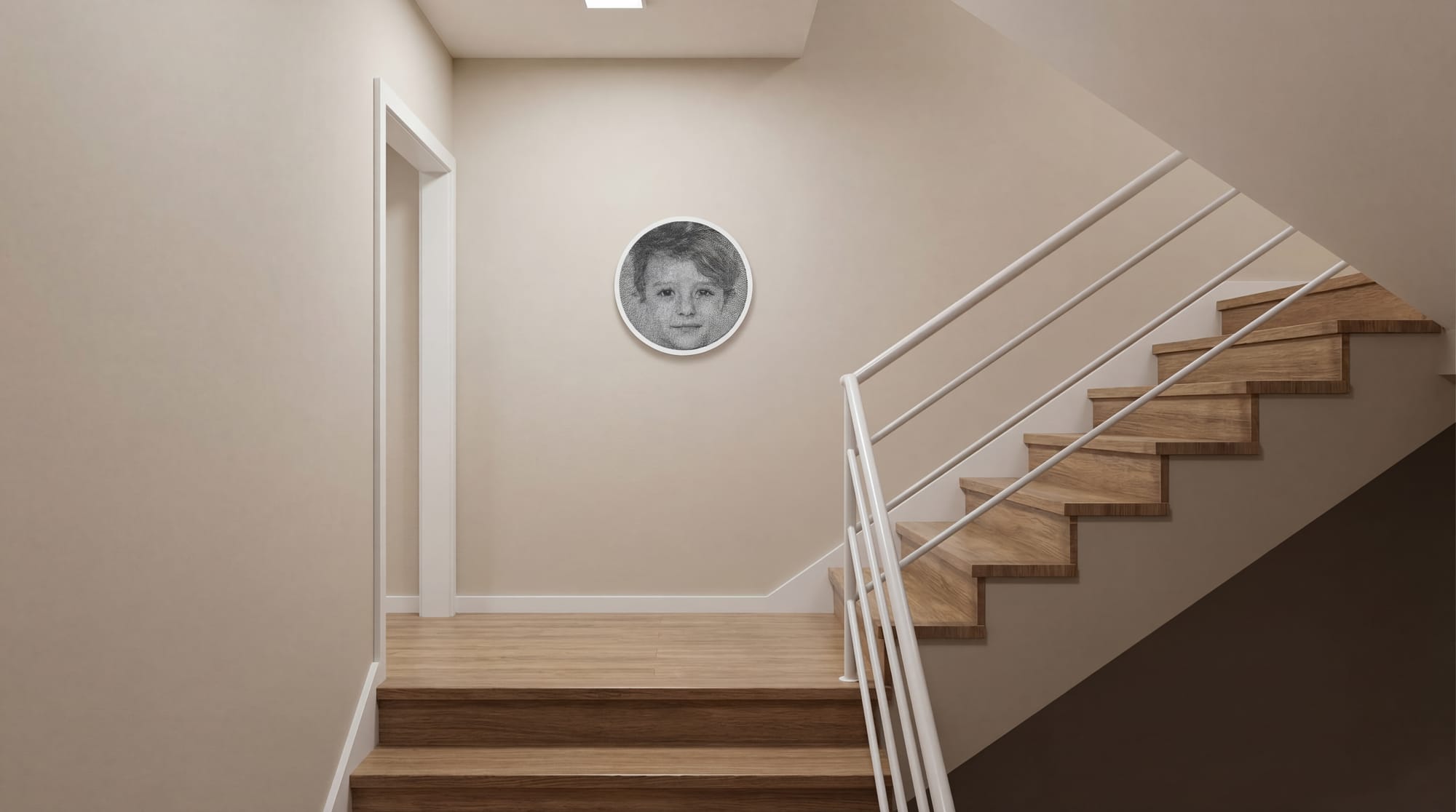
One of the most striking qualities of string art portraits is their shifting sense of presence. From a distance, the face appears cohesive and recognizable. As the viewer moves closer, the image fragments into individual lines. Step back again, and the face reassembles.
This oscillation creates a feeling that the portrait is both there and not there. The subject seems to emerge from the background, hovering between material and immaterial states. This effect is especially powerful with faces, where presence is closely tied to identity.
Eye contact plays a subtle role. Even when eyes are only implied, viewers often feel watched. As light changes or the viewer’s position shifts, the perceived expression can change as well. The face appears responsive, though it is static.
This illusion of presence without physical solidity contributes to the emotional intensity of string art portraits. They feel alive, but not fixed—close, but not intrusive.
Memory, Absence, and Emotional Resonance
Many viewers describe string art portraits as nostalgic or intimate, even when the subject is unfamiliar. This reaction is closely linked to how memory operates. Memories are rarely solid or complete; they are fragmented, layered, and subject to change.
The non-solid form of string art mirrors this quality. The face feels remembered rather than documented. It exists as an impression rather than a record. This can evoke a sense of closeness without specificity, allowing the portrait to resonate across personal experiences.
Because the image is not fully defined, it avoids the weight of permanence. The absence of mass and volume gives the portrait a gentle quality. It feels respectful, quiet, and contemplative rather than imposing.
This subtle balance between presence and absence is a key reason why string art portraits are often perceived as emotionally considerate, even when they are not explicitly framed as memorial works.
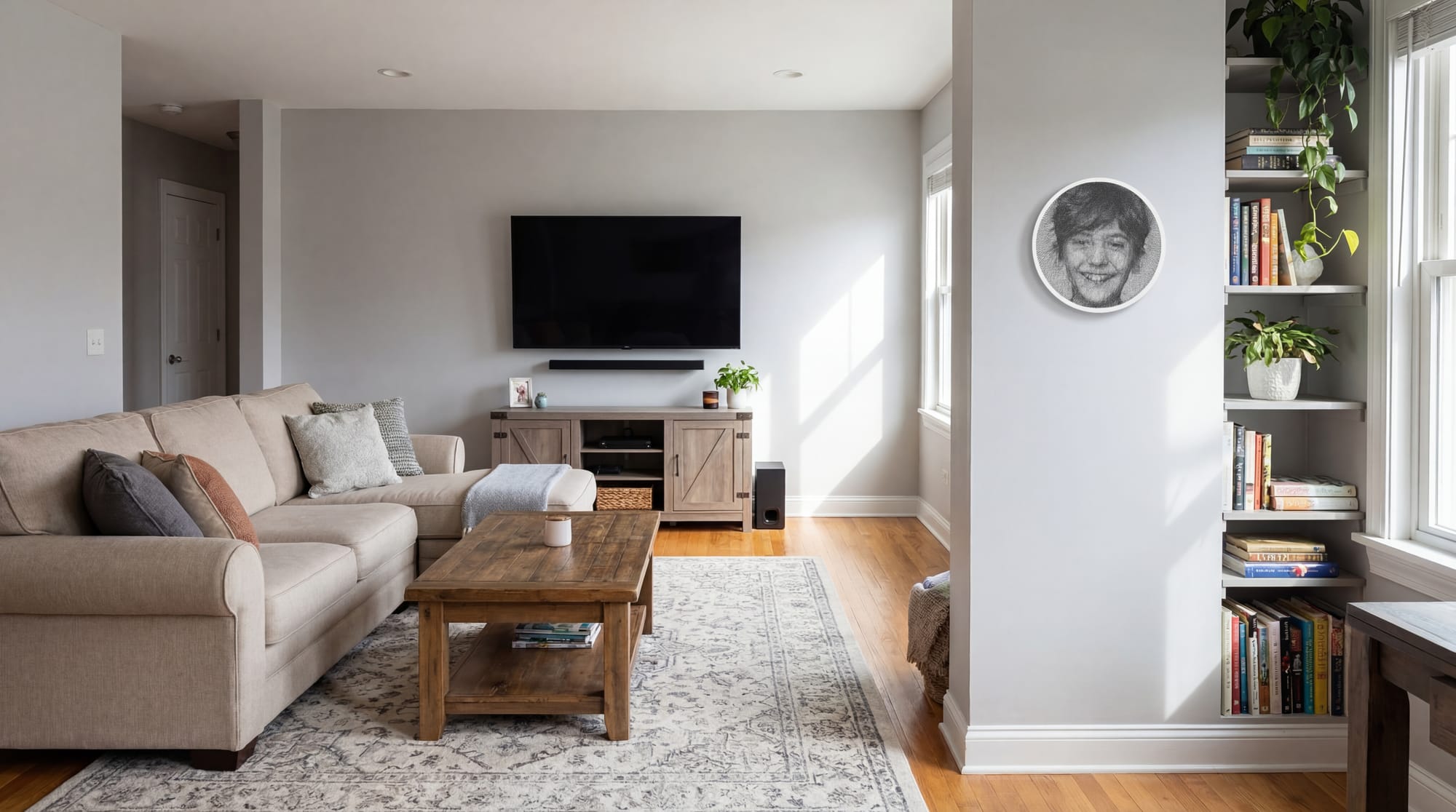
Minimalism and Emotional Space
Minimalism is often misunderstood as cold or impersonal. In reality, it can create the conditions for deeper emotional engagement by removing distractions. When color, form, and material are reduced, what remains gains clarity.
Modern string art embraces this restraint. Limited palettes and open space allow the viewer to focus on the face and its emotional tone. There is no visual noise competing for attention. The silence of the composition amplifies what is present.
In this environment, small variations matter. A slight shift in density, a subtle change in line direction, or a gentle shadow can alter the mood significantly. The emotional experience becomes quieter, but also more concentrated.
By leaving space around the subject, minimalism gives emotion room to unfold. The viewer is not overwhelmed, but invited.
Why String Art Portraits Feel Personal
Despite their abstraction, string art portraits often feel deeply personal. This may seem contradictory, but it is precisely the lack of specific detail that allows for personal connection.
Highly individualized portraits can feel distant if the viewer does not recognize the subject. In contrast, a face rendered through lines and suggestion becomes universal. It can represent anyone, or no one in particular. This ambiguity opens the door to emotional projection.
Viewers may see traces of themselves, of people they know, or of remembered faces from the past. The portrait becomes a mirror rather than a depiction. Its anonymity strengthens its emotional reach.
This quality explains why many people feel drawn to string art portraits even when they have no prior interest in portrait art. The connection does not depend on recognition, but on resonance.
Emotional Design in Modern Interiors
In contemporary interiors, art is increasingly valued for its emotional contribution rather than its decorative function. A room can be visually coherent yet emotionally flat. Art changes that dynamic.
String art portraits work particularly well in modern spaces because they balance emotional depth with visual restraint. They do not dominate a room, but they influence its atmosphere. The presence of a face introduces humanity without clutter.
Placed thoughtfully, such a portrait becomes a focal point. It encourages pause and reflection. The room feels more personal, more inhabited. This effect is not achieved through bold color or scale, but through emotional subtlety.
In this context, string art portraits function as emotional anchors rather than ornaments.
Art That Is Felt Before It Is Understood
One of the defining characteristics of emotional art is immediacy. The viewer feels something before they can articulate why. String art portraits operate in this way. The response comes first; explanation follows, if it comes at all.
This does not diminish their depth. On the contrary, it highlights a different mode of engagement. Not all art needs to be decoded intellectually to be meaningful. Some works speak directly to perception and emotion.
The language of string art portraits is quiet but direct. It does not instruct the viewer on what to feel. It simply creates the conditions in which feeling arises.
Conclusion: Why Less Can Feel Like More
String art portraits feel powerful because they align with how humans perceive, remember, and empathize. Through abstraction, line, and restraint, they activate deep psychological responses without relying on realism or excess.
By suggesting rather than defining, they invite participation. By remaining incomplete, they feel alive. Their emotional impact comes not from what they show, but from what they allow the viewer to experience.
In a visual culture saturated with detail and immediacy, this quiet intensity stands out. It reminds us that sometimes, less truly can feel like more—and that emotion often emerges most strongly in the spaces between lines.
Share this article Share to
Written by
Join the conversation
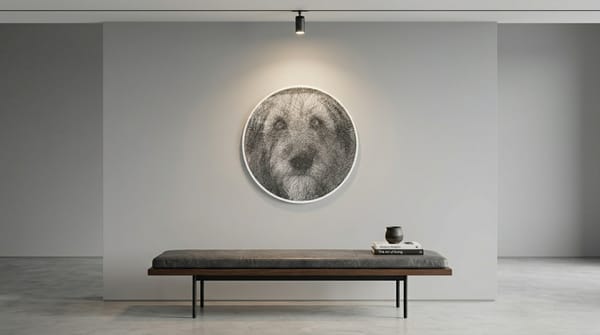
Pet String Art From Photo: Turning Your Dog or Cat Into Wall Art
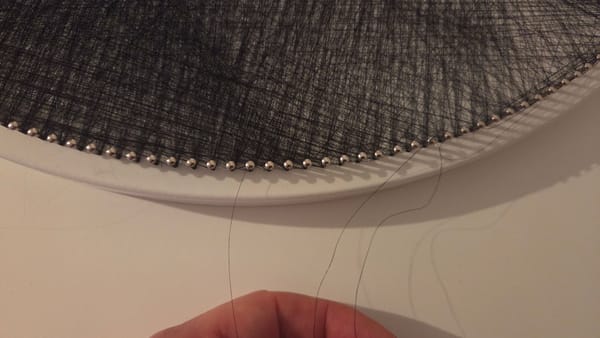
What to Do If the Thread Breaks During String Art
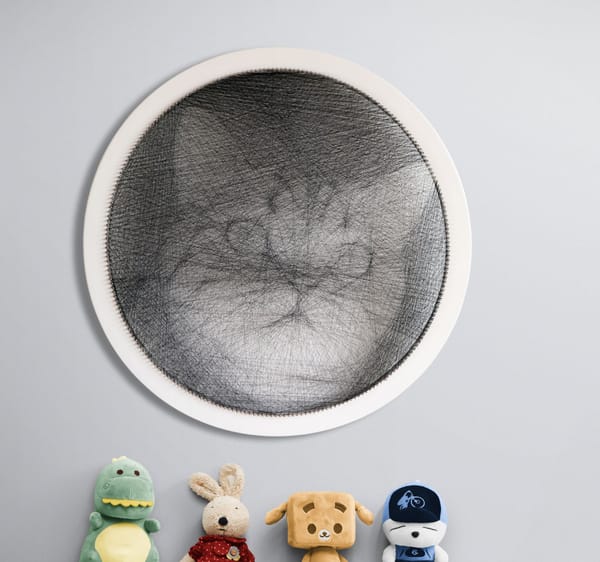
How String Art From a Photo Works: From Algorithm to Thread