


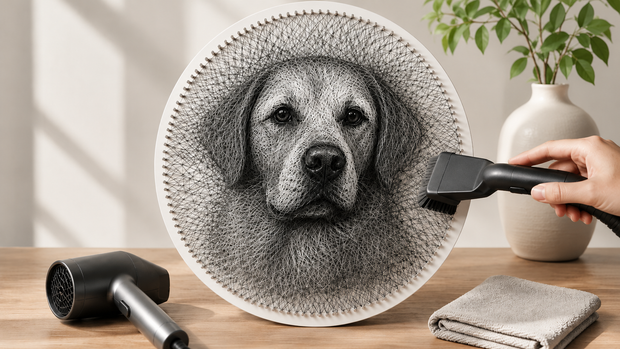
A finished string art portrait is more than a decorative object. It may represent a family member, a pet, a favourite photograph, an important memory or a meaningful gift.
After spending time creating your picture, you naturally want it to remain clean and attractive for many years. Fortunately, string art does not require complicated maintenance. Occasional dust removal, careful placement and a few simple precautions are usually enough.
However, the most suitable cleaning method depends on the construction of the string art model.
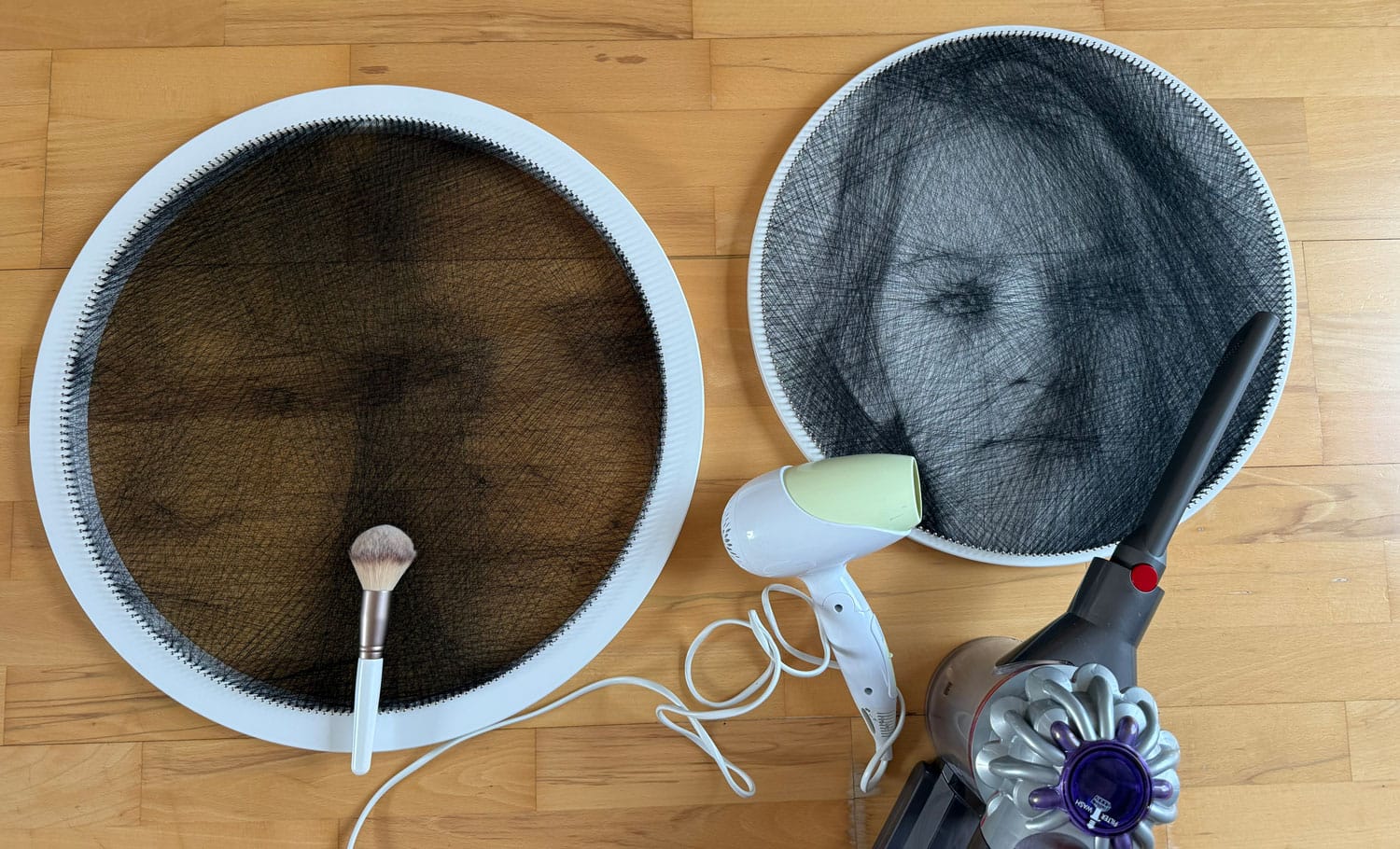
A Ring Model provides access to the threads from both the front and the back. This makes it possible to clean the threads gently with a soft makeup brush.
A Circle Model has a closed back panel, so there is no access to the threads from behind. For this model, a vacuum cleaner held at a safe distance or a hairdryer using cold air is more practical.
In this guide, you will learn how to clean both types of string art safely, protect your artwork from moisture and sunlight, and deal with a broken thread without remaking the complete picture.
Why String Art Needs Gentle Care
String art has an open, three-dimensional surface. The picture is created by arranging many individual thread lines around precisely positioned nails.
This structure gives string art its distinctive appearance, but dust can gradually collect:
- on the threads;
- between the thread lines;
- around the nails;
- on the frame or base;
- along the outer edge of the model.
Ordinary cleaning cloths are not suitable for the threaded area. A cloth may catch on a nail or pull a thread out of position.
Water, cleaning sprays, hot air and direct contact with a vacuum cleaner nozzle should also be avoided.
Regular, gentle dust removal is much easier than trying to clean a thick layer of accumulated dust.
The Best Cleaning Method Depends on the Model
Spatar string art models have different constructions, so the same cleaning method is not equally suitable for every model.
A Ring Model has an open centre. The threads are accessible from both sides, allowing dust to be removed with a soft brush.
A Circle Model has a closed back panel. Because the threads cannot be reached from behind, airflow is the easiest way to remove dust from inside the artwork.
How to Clean a String Art Ring Model
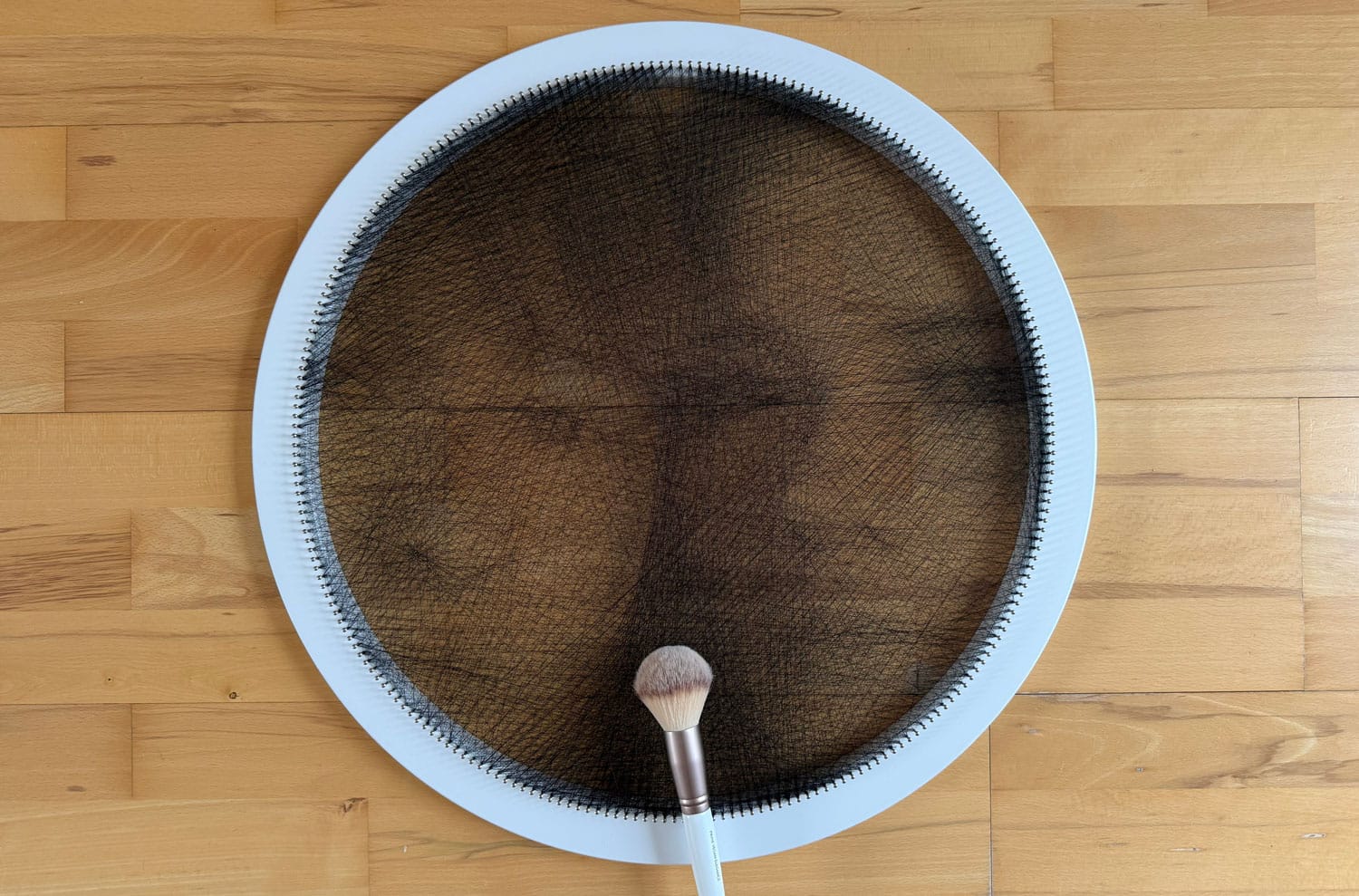
A Ring Model can be cleaned with a clean, soft makeup brush.
Because the centre is open, you can reach the threads from both the front and the back of the artwork.
The brush should:
- be completely clean;
- be completely dry;
- have very soft bristles;
- never have been used with makeup, cream, oil or other cosmetic products.
Move the brush gently across and between the threads. Do not scrub or apply strong pressure.
Start at the top of the artwork and work slowly downward. This allows loosened dust to fall away from the areas you have already cleaned.
You can clean the front first and then gently brush the threads from the back.
A vacuum cleaner or a hairdryer using cold air may also be used for a Ring Model, especially when dust has collected in an area that is difficult to reach with the brush.
How to Clean a String Art Circle Model
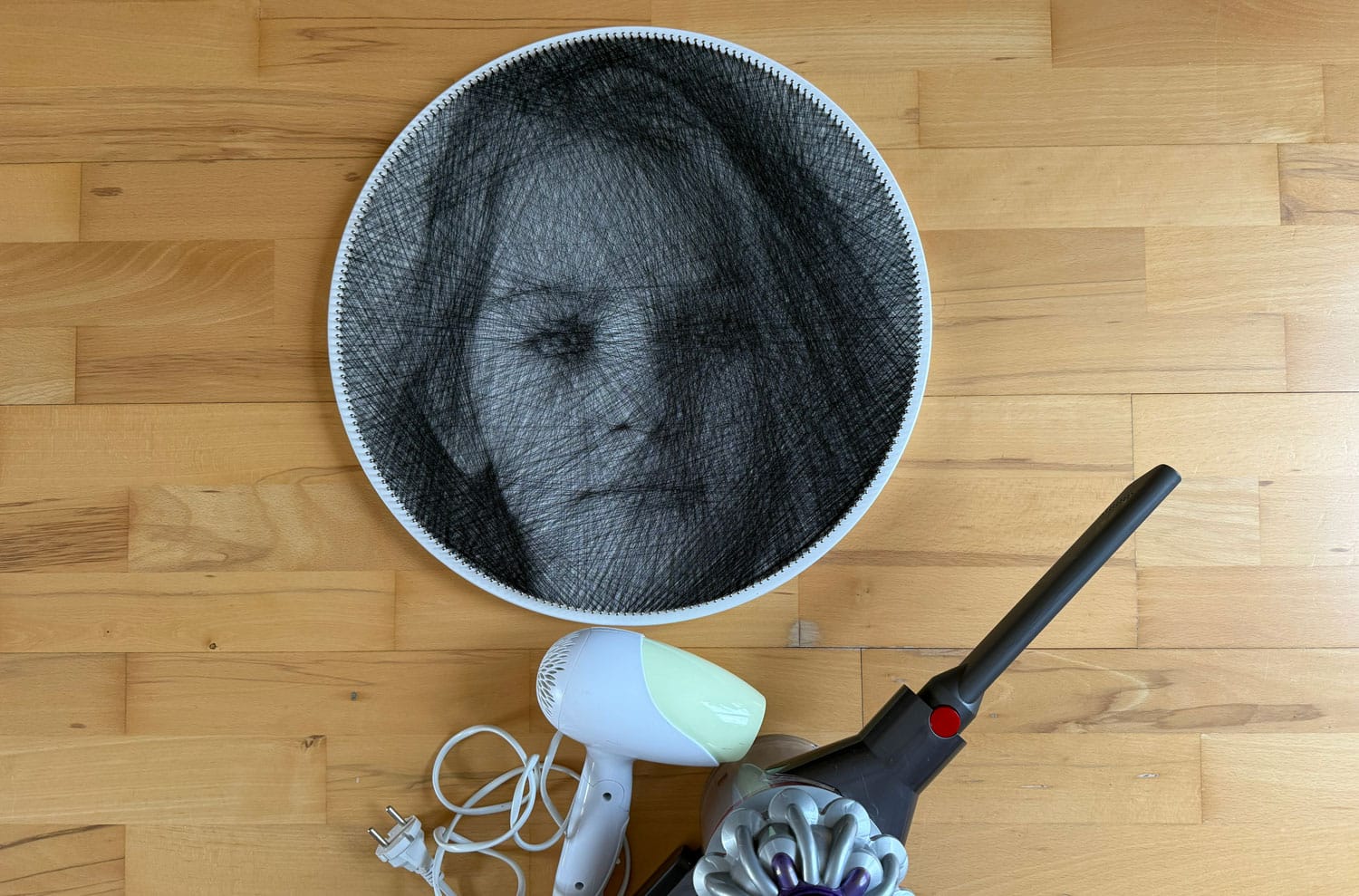
A Circle Model has a closed back panel. There is no opening behind the threads, so a makeup brush cannot easily reach dust inside the artwork.
The most practical cleaning methods are:
- a vacuum cleaner held at a safe distance;
- a hairdryer with the heat switched off.
Both methods use airflow to remove dust without requiring access from the back.
A soft brush may remove some dust from the front surface, but it cannot clean the inner areas as effectively as airflow.
How to Clean String Art with a Vacuum Cleaner
A vacuum cleaner is one of the easiest ways to clean a Circle Model.
Use low or moderate suction whenever possible. Hold the nozzle approximately 20 to 30 centimetres away from the artwork.
Move the nozzle slowly across the front of the model without touching the threads or nails.
Start at the top and gradually move downward.
The suction should be strong enough to lift loose dust but not strong enough to move individual threads.
Never press the vacuum cleaner nozzle directly against the artwork. Direct contact could:
- pull the threads;
- move a thread away from a nail;
- damage the frame or base;
- scratch or bend parts of the model.
When the vacuum cleaner has very strong suction, hold the nozzle farther away.
You can also use a brush attachment to distribute the airflow more gently, but the attachment itself should not touch the artwork.
How to Clean String Art with a Hairdryer
A hairdryer is another practical way to clean a Circle Model.
The heat must be completely switched off. Use only the cold-air setting.
Select low or moderate airflow and hold the hairdryer approximately 20 to 30 centimetres away from the artwork.
Move the airflow continuously across the picture. Do not direct it at one small area for a long time.
Start at the top and work downward so that dust is pushed away from the model.
Never use hot air. Heat may affect the thread, the base material or other parts of the artwork.
Even when using cold air, do not hold the hairdryer too close. Strong, concentrated airflow may move individual threads.
How Often Should String Art Be Cleaned?
String art does not need to be cleaned every week.
In most homes, checking the artwork every one or two months is sufficient.
The actual cleaning frequency depends on where it is displayed.
String art may need more frequent cleaning when it is placed:
- near an open window;
- in a busy hallway;
- in a room with many textiles;
- close to a frequently used door;
- in an area where dust collects quickly.
It may need less frequent cleaning in a quiet room with closed windows and regular household cleaning.
Light, regular dust removal is better than waiting until a visible layer has accumulated.
Cleaning the Frame and Outer Parts
The visible frame, ring or outer parts of the model can normally be cleaned with a dry microfibre cloth.
Wipe only the areas that can be reached without touching the threads.
Be especially careful around the nails because the cloth may catch on them.
For narrow areas, use a dry cotton swab or a small, soft brush.
Avoid using:
- wet cloths;
- furniture polish;
- glass cleaner;
- disinfectant;
- household cleaning sprays;
- abrasive cleaning products.
Never spray a cleaning product directly onto the artwork.
Cleaning Methods to Avoid
Some ordinary household cleaning methods are not suitable for string art.
Wet cloths
A wet cloth may catch on the nails and pull the thread. Moisture may also affect the frame, base or metal components.
Cleaning sprays
Cleaning sprays may leave droplets, stains or residue on the threads.
Hot air
Never use a hairdryer with heat. Only cold air should be used.
Direct vacuum cleaner contact
Do not press the vacuum cleaner nozzle against the threads or nails. The suction should work from a safe distance.
Sticky lint rollers
A lint roller may stick to the thread and pull it out of position. It may also leave adhesive residue.
Stiff brushes
A toothbrush, hard paintbrush or household cleaning brush may catch the threads or scratch the model.
Compressed air at close range
A strong stream of compressed air may move the threads. Some compressed-air products may also release moisture when used incorrectly.
What to Do If One Thread Breaks
A string art picture is created from many individual thread lines.
When one thread breaks, it will normally not noticeably change the complete picture. One missing line among the many lines in the design is usually practically invisible.
There is no need to undo the artwork or recreate the whole picture.
Simply secure the loose thread ends with small, tight knots.
Depending on where the break occurred, you can:
- tie the two broken ends together;
- tie each loose end around a nearby nail;
- secure the thread behind the surrounding thread lines.
Place the knot close to a nail whenever possible. This makes it less visible and helps keep it securely in position.
Do not pull the loose thread excessively tightly. It only needs enough tension to remain secure and prevent further loosening.
After tying the knot, gently move it behind the other threads where possible.
What If Several Threads Break?
Several broken threads may be more noticeable, especially when they are located in the same part of the picture.
Do not remove the surrounding threads.
First, secure all loose ends with knots so that the affected area cannot loosen further.
Take a clear photograph before attempting a more extensive repair.
In many cases, additional thread can be placed between the relevant nails to restore the damaged lines without rebuilding the complete picture.
When you are uncertain, contact Spatar and include photographs showing:
- the complete artwork;
- the damaged area;
- the loose thread ends;
- the nearby nail numbers, when visible.
This makes it easier to identify the best repair method.
Keep String Art Away from Moisture
String art should be displayed in a dry indoor environment.
Avoid placing it directly beside:
- a shower;
- a bathtub;
- a kitchen sink;
- a kettle;
- a humidifier;
- an open window during rain;
- an area with frequent condensation.
Bathrooms are generally not ideal because humidity levels change repeatedly.
A kitchen can also be unsuitable when the artwork is close to the cooking area. Steam, oil and cooking residue are much more difficult to remove than normal household dust.
When displaying string art in or near a kitchen, choose a wall well away from the stove, sink and other sources of steam.
Avoid Excessive Heat
Do not place string art directly above or beside:
- a radiator;
- a fireplace;
- a heater;
- a hot-air outlet;
- a powerful lamp that produces significant heat.
Normal indoor room temperature is suitable.
The main goal is to avoid repeated exposure to concentrated heat.
Choose a Safe Display Location
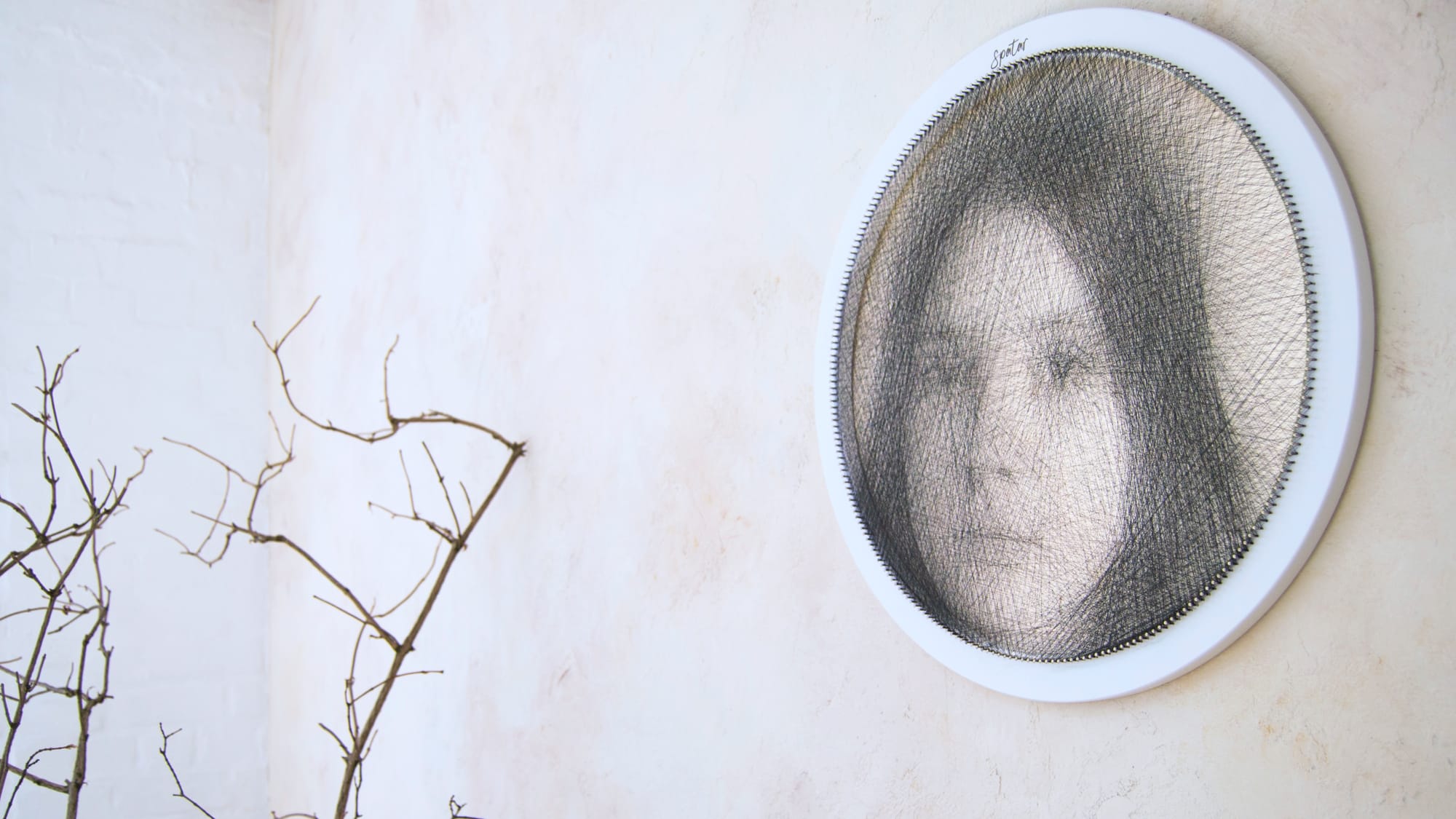
The correct display location helps prevent accidental damage.
Avoid walls where people, clothing, bags or furniture may regularly touch the artwork.
A hallway can be suitable, but the model should not project into the walking area.
Place the artwork where:
- doors cannot strike it;
- children cannot pull the threads;
- pets cannot reach it;
- indoor plants do not touch it;
- curtains do not rub against it;
- furniture cannot be pushed into it.
Make sure the wall fixing is appropriate for the size and weight of the model.
When hanging string art above a sofa, bed or desk, check that it is attached securely to the wall.
How to Store Finished String Art
When the artwork is not being displayed, store it in a clean, dry indoor location.
Do not place heavy objects on top of it. Pressure may bend nails, move threads or damage the frame.
For safe storage:
- Remove loose surface dust.
- Place the artwork inside a strong box that is slightly larger than the model.
- Prevent the artwork from moving inside the box.
- Protect the front without pressing packing material directly against the threads.
- Store the box upright whenever possible.
- Keep it in a dry cupboard or storage room.
Avoid storing string art in a damp basement, garage or attic where temperature and humidity may change significantly.
How to Transport String Art Safely
String art should be protected carefully during transport because exposed nails and threads may be damaged by pressure.
Use a strong box with enough space around the artwork. The model should not move freely inside the package.
A rigid protective panel may be placed in front of the artwork, but it must not press directly against the threads.
During transport:
- keep the model upright whenever possible;
- carry it by the frame or base;
- never lift it by the threads;
- do not place heavy luggage on top;
- protect it from rain;
- do not leave it inside a very hot car;
- secure it so that it cannot fall during sudden braking.
Before transporting a personalised artwork, take a photograph of its condition.
A Simple String Art Care Routine
String art maintenance does not need to be complicated.
Every one or two months
- Check the model for visible dust.
- Clean a Ring Model with a clean, soft makeup brush when necessary.
- Clean a Circle Model with a vacuum cleaner or a cold-air hairdryer.
- Check whether any threads have become loose.
- Make sure the wall fixing remains secure.
Every six months
- Check whether direct sunlight now reaches the artwork.
- Inspect the model for signs of moisture.
- Clean the frame or outer edges with a dry cloth.
- Make sure plants, curtains or furniture are not touching it.
Before storage or transport
- Remove loose dust.
- Secure any broken or loose thread with knots.
- Photograph the artwork.
- Place it inside a correctly sized protective box.
- Avoid pressure on the threaded surface.
Frequently Asked Questions
Can I clean string art with a makeup brush?
Yes. A clean, dry and very soft makeup brush is suitable for a Ring Model because the threads can be accessed from both the front and the back.
For a Circle Model, a brush cannot easily reach inside because the model has a closed back panel. A vacuum cleaner or a hairdryer using cold air is more practical.
Can I use a vacuum cleaner on string art?
Yes. Hold the nozzle approximately 20 to 30 centimetres away and use low or moderate suction.
Never allow the nozzle to touch the threads or nails.
Can I use a hairdryer?
Yes, but only with the heat switched off.
Use the cold-air setting and keep the hairdryer at a safe distance from the artwork.
Can string art be washed with water?
No. Do not wash or rinse string art.
Moisture may affect the thread, frame, base and metal components.
What happens if one thread breaks?
Usually, nothing noticeable happens to the complete picture.
String art contains many individual thread lines, so one broken line will not normally change the overall image.
Simply secure the loose thread ends with small knots
Do I need to remake the picture after one thread breaks?
No. There is normally no need to reconstruct the artwork because of one broken thread.
How often should string art be cleaned?
For most homes, checking and cleaning the artwork every one or two months is sufficient.
Can string art be displayed in a bathroom?
It is not recommended because repeated humidity and steam may affect the materials.
Can string art be displayed in a kitchen?
It can be displayed in a kitchen when it is kept well away from the cooking area, steam, grease and water.
Keep Your String Art Looking Its Best
Finished string art requires only simple care.
For a Ring Model, use a clean, soft makeup brush to remove dust from the accessible threads on both sides.
For a Circle Model, which has a closed back panel, use a vacuum cleaner held at a safe distance or a hairdryer with the heat switched off.
Avoid water, cleaning sprays, hot air and direct contact with the vacuum cleaner nozzle.
Keep the artwork away from prolonged direct sunlight, moisture and concentrated heat.
Check the threads occasionally. When one thread breaks, simply secure the loose ends with small knots. One broken thread will normally have no visible effect on the complete picture.
With these basic precautions, your personalised string art can remain an attractive and meaningful part of your interior for many years.